


“Hutton, 3/17/84.”
The registration desk at the surgical pavilion was darker than I remembered. A middle aged, bearded man in a Seahawks jersey looked at me, listening, nodding, glancing down at his roster.
“Now that is a great birthday.”
Why yes, it sure is. I told him most people don’t put it together, the 17th of March being St. Patrick’s Day.
With an ID bracelet on, we sat for a spell near large windows. I opened a memoir I’ve been willing myself to finish, slowly. I’m called back and the CNA seems to notice I know exactly what to do—I explain I’ve been here a few times before. I disrobe and burrow into the gown and hospital bed, jotting down observations on my pocket notebook. I am hungry but resolved to stay in a bright, cheery mood.
A nurse who is probably an IV whisperer (every hospital has a handful of these people I imagine) stops by and starts asking questions about my surgery so she can poke me accordingly. I explain I’m having a tumor removed, a cancer in my nasal area. She decides the right arm is ideal because it is—the vessels on the left have been modified significantly, owing to the harvest of the forearm flap.
I watch her prepare, tightening the rubber tourniquet around my arm, just above the elbow, gently tapping and massaging the vein she’d like to use. She numbs my arm with lidocaine and inserts the needle attached to the end of the IV catheter. She waits, pausing briefly, using the fingers on her other hand to move the vessel back, adjusting the angle and direction of the needle, and then effortlessly glides the flexible tube in and needle out in a single motion. Blood fills the space between the tiny hole in my arm and the pale blue plastic bit with the bright green cap. The IV is secured with tape and I continue to wait and listen and write.
I meet Caesar next, my pre-op nurse. He says he will take great care of me and keep me apprised of what to expect before and after surgery. We go through a list of screening questions that are mostly no’s until we start talking about implants and cancer. Caesar’s affect, his presence in the room, the way he speaks to me—I know he is a kind and caring person and an experienced nurse. When you’ve done this long enough, you notice the newbies, the staff members trying to get their bearings, fumbling a bit, awkward and earnest. They stand in contrast to the seasoned nurses who move with confidence and authority, the best of whom guide a patient in the way that best suits their needs. In that first meeting they are assessing, picking up on little clues.
Caesar tells me he appreciates that I’m smiling and laughing right before surgery. I tell him it’ll be more of the same after I wake up from anesthesia. He fetches Lindsay and the three of us are chatting about my surgical history, the challenges of healthcare in the COVID days. He tells us stories about holding up iPads in the ICU so patients could see their loved ones. I imagine this has weighed on Caesar, but also informs how he cares for others, having been so close to pain and death, seeing others suffer and mourn from a distance.
The OR nurse stops by next and we talk about the gameplay for today. He seems a bit stiff and uncomfortable, interacting with patients who are awake probably isn’t a big part of his job. We talk about implants and removables again and I show him the containers my hearing aid and obturator will go in before I’m rolled to the OR. He departs and Dr. Humphreys appears, casual as always.
“Hey, it’s Ian”
He asks if we have any concerns (we don’t) and then I pepper him with questions about the craft of surgery. He tells me how, in the past 10 years or so, there’s been real advancement in the foams, liquids, and lattices used in surgical settings, whenever tissues are being removed. He also recommends I check out sinusvideos.com to sate my curiosity. We talk for a bit about his fellow, Luke, who will be part of the surgical team. We’d met the Aussie doctor during a prior appointment and he’d quickly passed my version of a litmus test, which is how quickly I can get a provider laughing or vice versa. Upon meeting Luke, he apologized for running late, noting that he’d been reading my chart.
“Yeah, makes sense, there’s a lot there”
We both laugh, knowingly. None of this needs to be too serious.
I don’t get a chance to greet Luke but I’m pleased to know that he’s involved and my case is part of his surgical fellowship.
Jeff the anesthesiologist introduces himself. I notice he is the attending physician, based on the tag below his name badge. We go over all of my risk factors for general anesthesia, which is a short conversation. Jeff says that even my cancer isn’t really a contributing risk—I am basically the most boring and straightforward case an anesthesia team could ask for. Funny how that works.
Jeff’s surgical assistant is ready to take me to the OR—hearing aid and obturator stowed, cap on, and we are moving down the hallway. Moments ago he’d asked if I wanted some Versed. Why the hell not? The feeling of relaxation and calm is nearly immediate. I wasn’t worried or anxious so this is all upside, just pre-op bliss.
We are in the OR and I slide on to the table. It’s not as cold as I remember, perhaps because my time here will be brief. I am breathing deeply and smiling a little, tranquil and calm. The oxygen mask is my last waking memory.
Nurse Kevin is moving me from the OR to recovery. I am fully awake and he is surprised.
“Oh wow…you’re awake already. Okay.”
Kevin brings me applesauce, jello, and juice and then we are talking about prescriptions—pain meds I probably won’t want or need but decide to pick up anyways.
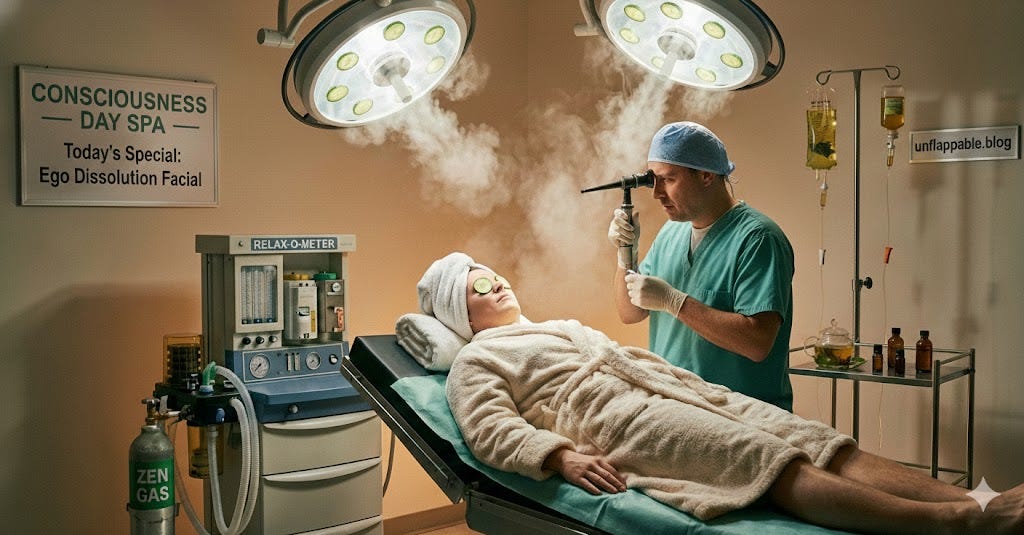
The drive home is uneventful for a Wednesday afternoon. I agree to relax, just for today, even though the surgery was more like a trip to a day spa. I feel lucky.
You make surgery sound like an easy social event.
Title is genius